9.21.2007

Nobody works harder...

The wife and I like to save together.

We bike to work; saving on gasoline, & gym costs. When not biking, we carpool in a 4-cylinder Honda 4x4 SUV (24 mph top). Rarely do we drive more than 80 miles in a given week (some days we don't drive at all). Even-though most of our driving is city for which we get lower gas mileage. We offset the cost by seeking the cheapest gas prices from one of 5 gas stations we drive by. Also by the low cost of maintenance on a Honda (second highest resale vehicles in the US).

We clip coupons and use credit card rewards. Diners card gives Buy one, Get one offers. Or $5 - $7 discounts at "nicer" restaurants. We have probably saved over $100 (Diner's Card only costing $25) already this year. We use Speedy Rewards, 4 cents off gas and purchase it with our Menard's Big card for extra rewards (coupons).

Menards Big Card

The wife uses grocery coupons from the internet. Print off only the coupons you need. Usually can be used with other discounted offers and sometimes don't expire for 3 months.

-We get Free by mail coupons. Signed up for Noodles & Co. "Noodlegram" every year we get 2 Buy one, Get one entree. Also get a free cookie with the "I Voted" sticker on Nov. 1st. Menard's Big card offers free (or very cheap) hardware with rewards.

We often check the best price online (incl. groceries via Simon Delivers). When we consider purchasing some type of luxury. We usually spend days if not weeks seeking the best price. We use websites PriceGrabber & Campusi. We pay attention to daily internet deals from REI-Outlet, NewEgg, DealHack, & especially SlickDeals.net. -This might annoy a few of you that recently bought some items without checking for the best deal.



We prefer to see movies at the $1.50 theater (went to some free midnight showings last month). Or a triple feature drive-in ($7.50 a person to watch 3 current movies on a large screen). Or McDonald's RedBox. (Free movie rental with codes)


We take an effort to only buy what we would use, even if it is a "deal of a lifetime". Learning from our wasteful spending habits in the past questioning whether a purchase is important enough to use capital that might be better used in the future.

We expect to be compensated when service or product does not live up to expectation. And plan to follow through with a complaint. This year alone we got an upgrade to the latest Treo (755p), $55 cellphone credit, & $30 Comcast credit.

**Also keep in mind that there are website forums that also mention where good deals are found. (e.g. BargainShare.com)

On top of saving money we both have hobbies that have income potential.

-The wife sells scrapbooking supplies. This supports what could be an expensive hobby. She gets a percentage of what her client base purchases. It is also provides tax write-offs for purchases we would have done anyway (computer, camera, vacations, &c...).

-I track investment markets.

Below I have included some websites that give you a serious advantage in these markets.


StockFetcher 2.0
Significantly better than StockCharts.com Stock Scan. Programable scans allows you to custom a scan that has provided you with individual results. Not some overused predefined indicator results that a Contra-trader might use against you.

FXStreet: Currencies at a glance
Comments, Hourly Charts, Analyst Sentiment, Forum, & News Analyst comments all on one page. Perfect for someone who would like to ease themselves into the foreign exchange market. You can look here for some possible trade ideas.

In the past I have subscribed to InvestorFlix for some investing advice. Just like NetFlix, you rent different seminars (with PDF document of the seminar notes) then return them when you are done. You can rent 2 at a time and when you are done just mail them back in the envelope. Costing only $20 a month. An entire year costs $240. Each seminar would cost at least $500, some over $3000 to attend. This would have saved me at least $4,000 -possibly $10,000+ on training. These are different seminars with different perspectives from different people. You can learn what you like and create your own strategy.



Cut wasteful spending, Start saving, Start investing ... your time and your money... to eventually get what you want out of life!

Labels: , , , , , , , , , , , , ,

3.10.2007

USD $1,000,000.00 and other ramblings

Today I have the opportunity to speak to someone of whom has "a million dollars" that could help me get "a million dollars." Which begs the question, what exactly is a million dollars?

It is a very large round number of the worlds most popular currency. One hundred ($10,000) bricks of $100 dollars. Nothing more, nothing less.

How could I get a million dollars? Objectively speaking, it isn't difficult to get a million dollars quickly. Two words; Fraud & Theft. There is also gambling & savings (Not really worth talking about).

To legitimately have "a million dollars" in your possession you must create a organization and/or invest in a financial instrument. This is probably what the millionaire is going to tell me. He is emphasize being a "marketing entrepreneur" (may or may not use that specific term) making a margin on an already successful product line by being the "middle man." He is going to emphasize on how increasing your debt will increase your return. He is going to emphasize image (guy lives in a 6,000 sq foot house)...

To be a rich "marketing entrepreneur" in America you must increase your debt load with business loans. Loans in case you didn't know, cause a great deal of inflation. They widen the wealth gap, thus encouraging bankruptcies and poverty. They mostly benefit large financial institutions in my opinion. You also must have an image. Which equates to unnecessary waste. It also emphasizes an unrealistic American entitlement. Encouraging people to purchase items that they otherwise could not afford. Not only do American entrepreneurs borrow irresponsibly, they encourage others to do the same.
To win, you must be on the right side of Usury & Technical Receivership.

Or you could invest in a financial instrument. US Equities encourage the scenario mentioned above. You can "vote with your feet" to these practices by shorting the US Indexes. However, timing odds are not in your favor. As they say, 75% of the time stocks go up -but go down 2-3x as hard. You could be a "bond bull" to discourage lending. You could trade commodities, however the US government and tyrannical oppressive corporations are involved there.

So what is one (who is conscionable) supposed to do? Live in a small Mexican, Spanish, Italian, or French village selling wares to whomever stops by? You want to make a difference in this life. Not just live in a peaceful existence. Until I find something different, I feel that the most conscionable investment is currencies. If there is a government policy that I do not like, I will be biased to short that currency given the opportunity.


Everyone must realize that net worth is the most important metric when it comes to success. Not automobiles, square footage in house, neighborhood, number of employees, or earnings per quarter.

In my opinion what is a true indicator of success is self reliance/sufficiency, and flexibility. The ability to work when, where, and how you want to whenever you want to. In contrast, one who has employees, vehicles, and other debt is only working for the bank and their employees.

Let's remember, (American) employees are a hassle. They rarely show up to work on time. For the most part, they will say or do anything to get the most out of you or your company. You need to pay them first (before your client pays you) whether or not you think they did a satisfactory job. In order to remain competitive, you even need to pay them (sick pay, holidays) when they don't even show up to work. They don't share in any of the risk, and take aggression out on you if you have to cut their hours. They expect you to sacrifice your own back-breaking profits to subsidize their mostly lazy lifestyles.

I believe the less you are dependent upon employees, clients, suppliers, or a certain market condition; the better your working life will be.

Let's not forget the real "benefits" of being a marketing entrepreneur (aka business owner). If you were to misinterpret real demand in any area of your operation, your business could be one of the statistics (9 out of 10 businesses fail within the first 5 years).

So does that mean that you should be a hippie then? In some ways, yes. A hippie with a high net worth. You must maximize all the capital (labor, land, & money) that you have. Does it means that you need to make your own window cleaner, laundry soap, install solar panels, drive a hybrid vehicle, or have an organic garden for natural remedies? Yea. That is what I am saying. Anything (responsible) to maximize your dollar.

You also need to have an extensive knowledge of market reaction to exogenous conditions. If it's raining in Brazil, buy Starbucks. You may ask, how am I providing jobs if all I do is invest in the companies that provide the jobs. The answer is, I provide liquidity. I provide companies and individuals the capital to invest in markets that have an anticipation of growth. Capital naturally goes to the places & people that make the best use of it. And let's face it people, there is only so much capital around. There only so much labor and land. The bank may print more money, but every succeeding dollar has less value. So you got to be smarter and work harder than your neighbor.

Some less socially responsible ways that people have maximized their dollars are: putting soup kitchens in populated cities to attract a larger employee base thus equating to lower wages, employing temp workers to avoid paying benefits, employing workers that are commission only to avoid paying them first (only after the company gets thier profits), and the list goes on....

These are horrible ideas. Especially when productivity is decreases every time an employee feels that they are not getting what they deserve.


As the face on the C-note says, "There are two things you can't avoid in life, dead & taxes." Taxes will be largest expense you will make during your life. I heard (forgot where) that in the 1940s only 5% of the people paid taxes. It seems like every year the government gets more greedy, oppressing hardworking citizens for irresponsible pork spending. Social Security, Medicare, Medicaid, Welfare programs, War on Terror -the list goes on. I am not here to argue the Politics, just the point that taxes discourage investment / free market enterprise.

Taxes can make a profitable venture into one that barely keeps up with inflation. I will explain two examples of this. Rental Real Estate & Day Trading Stocks.

If you have rental Real Estate property, according to the recent tax laws, you must pay capital gains on every unit of property being rented. Who would want to put money in their rental units if they are just going to be paying taxes for any returns on those units? By contrast, capital gains taxes from the house that you live in can be deferred into your next property. So why would someone want to invest in doing upgrades to one's rental real estate if they are just going to be taxed on any increase in evaluation? They wouldn't. I feel that this type of policy encourages apartment slums.

Taxation has also made day trading stocks (buying the equity, not stock options) a losers game. You get taxed as a short term investments on top of trading fees. That means that in order for your day trades to be worth while, you need to be getting a much greater ROI to make up for the higher taxation. In most cases, after fees and taxation, you would be better putting your money in a dividend yielding ETF for the year (getting appreciation for the fund and dividends to reinvest).

On a side note, publicly traded stocks are not a physical asset. Prices are determined entirely by comparisons & speculation. Even the most seasoned stock trader loses sleep now and then. Especially if the stock is more than 35% owned by institutions. US stocks go up 75% of the time, but go down twice as fast. If you aren't diversified, than the odds are better in Vegas.

Labels: , , , , , , , ,

2.18.2007

Finding Profitable Portfolios

I love to maximize time. I am more than willing to spend 8 hours one day to save 10 hours or more later. So that is what this is about

A coworker of mine has offered to pay a percentage of profits from my picks. Usually when I pick stocks, I go between looking at price movement/volume with some other exogenous factor. As the last set of picks went, I realized that sometimes my so-called "Long Term" trades yield more than the "Short Term". In order to extract which factors truly make wise trades, I have made the following list. Each one originated by a Stock Screen weighted in it's own category.

Sector:
LFL 75.25
FCN 33.09
TALX 35.95
CEN 34.25
NHP 34.26
PKY 56.53
TCO 62.63
SPAR 22.97
CTB 16.56
CG 72.93
AGU 38.77
MOS 25.23

Trendy:
SABA 7.62
TRIB 9.88
ICGE 11.77
EXFO 7.28
NXST 7.50
CRAY 13.61
IBAS 9.96
ISPH 7.83
CHR 7.58
MPP 10.70
MPWR 13.71
RAMR 16.03
SPIR 9.32

Oscillating:
QCOM 42.51
SIAL 41.62
ORLY 34.66
SGMS 34.14
LNDC 13.40
ACLS 7.64
HON 47.83
LDG 46.52
CPF 39.96
NWL 31.51
LUK 28.50
HBI 26.78
CHR 7.58

Volume:
BOBE 36.64
TLEO 15.13
DMRC 12.20
SHG 122.01
BAM 54.40
TIN 53.16
GR 50.85
ADP 50.96
AET 45.61
NWL 31.51
TRW 29.26
JNS 22.30
BKC 22.61


After a couple of weeks or months, we will gauge the median returns. If the returns are substantial enough, I might even send out a newsletter. At first, it would be free. -It does take a bit of time to distill and filter these down. Let's call them Adam's Lucky 13 (on Sector, Trendy, Oscillating, Volume).


And as always, if you make some money off of these picks... please contribute to the HookShow Podcast.

Labels: , , , , , ,

2.01.2007

Some more stocks, bleh...

I am sure that there are not very many people like my stock pick posts. Even I can admit that it is not all that exciting.

I could include the words "Boo-ya Skee-Daddy" in with the post. -Maybe I would get some comments to my picks. Possibly people might think that it is easy to pick stocks (US equities), and therefore are not impressed. Perhaps there are those who don't care about so called business and would rather spend thier free time discussing the lastest installment of "I love New York" or the Superbowl.

Here are some picks I found tonight for a co-worker.

Short Term (take profits of 10% -20% and never look back)

PANC 4.19 profit target 5.30 (possibly 6.79) 20.9% (possibly 38.3%)
VIRL 8.33 profit target 9.25 (possibly more) 9.94%
pay attention to these daily, then could easily go against you if you don't pay attention -high returns = high risk


Long Term (monitor performance ever 2 or 3 days paying attention to price action & volume)

FCEL 6.64
RADS 11.37
ride these until a significant sign of weakness


And as always, if you make some money off of these picks... please contribute to the HookShow Podcast.

Labels: , , , , , ,

11.10.2006

penny for my thoughts

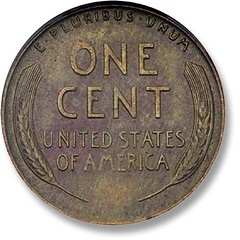
Two days ago, I watched a co-worker of mine proceed to drop pennies (copper 1 cent piece) in the trash. I was astonished. He was looking for change to get something from the snack machine, I offered him 3 pennies (not nearly enough for a snack, but that is what I was willing to give). Without blinking he cupped his hand around the pennies and dropped them into the trash. -Such disregard for money. It was like pennies are scrap metal w/o any resale value. Now, I could respect him saying "keep your pennies", but throwing away my gesture of currency... Here are some hard numbers for those who dislike the (highly liquid, metal is worth more than the face value) penny.


Saving 15 cents a day (an arbitrary illustration figure) after 5 years you would have 273 dollars & 75 pennies. -Not a lot, granted, for 5 years worth of conscience effort. After 30 years, 1,642 dollars & 50 pennies. -If you invested the $54.75 per year into an Index Fund with an average ROI of 8%, after 30 years you would have $6,800.51 (w/o taxation or dividends). Averaging 226.68 per year. The more you put sooner, the better the final number. Now let's be honest, that is a decent number... however, we all know that we could get the same returns with less effort (daily putting aside money) and opportunity costs by just simply saving $18.89 a month for 30 years.


What's most important about appreciating pennies is the derivative intangible benefits. It has to do with the fact that money goes to were it is better appreciated. Money has but this one prejudice. You must appreciate money in all of it's forms. Money is attracted to the one who takes care and monitors their money. "He who is responsible with little...." It all starts with a conscience decision today that you will never, ever purpose to throw away money. Unlike marriage, with money you should place emphasis on the details. Pay attention to how many pennies are being wasted every time you don't use a coupon or take an extra trip to the grocery store. Ask yourself if it is worth the waste. Of course, in this society we can never be 100% efficient. There is going to be waste, lots of it. But we should try to maintain it as best as we can.


But that is not all, coins have collector value (if you don't clean it first). In this article, the collector mentions that a circulated (one you might find lying casually in the street) 1813 penny could be anywhere from $200 to $900. It might take you a while to find this specimen, but if you already have money (penny) saving habits clearly established I am convinced that you will eventually find a gem of this sort.

If you have been monitoring my site, I recently put up hard commodities & bond charts. A casual mutual fund (buy and hold for the long term) investor might think that this is a waste of time monitoring these indicators. But I have to disagree. In fact, you have to be either living in a cave or blinded by pride to think that buy and hold is going to comfortably take you into retirement. There needs to be a balance. "Trade less, not more. Every trade is an opportunity to lose." -Larry Williams. You can't just keep blindly buying into a market. Strategize. Have defined rules as to what would take you out of a market, and what would make you enter a market. The exit is always more important that entering a trade.

Keep in mind that bond prices drop before a stock market "correction". Bond prices are associated with the value of the U.S. Dollar, the greedy capitalistic nation it is. When there is less demand in United States Bonds, the bears have essentially made their case for a devalued dollar. This could be because the government was 'printing' too much money (increasing the amount which banks can loan versus the cash in vaults, lowering the interest rate). Too much of this 'cheap money' going around makes the dollar itself worth less. When bonds go up, it is assumed that there is less money being 'floated' (interest rates make money less accessible, banks have more money in their vaults). When our dollar is worth more, US backed securities are very attractive to foreign investors. Foreign investors like to take advantage of the high yield on our interest rates. Banks increase the interest that they are requiring for a loan and thus they can pay more interest.


Gold on the other hand, correlates to fear. Those who (like myself) have a holding of gold (or silver, platinum, & palladium) assume that the dollar will eventually 'break' and that tangibles are going to be in high demand. The fact that our fiscal currency is only backed by what number is written on the piece of paper (by the fed), is discouraging for some people. In the years of 'yore', the first banks were goldsmiths. These goldsmiths where the ones who took deposits and wrote out loans against their holdings. When the foreign investors (namely European and Middle Eastern) start withdrawing large lots of money from our economy, our dollar will become depressed. This could be brought on by many different things. The most popular reasons for those world banks to lose faith in our economy is national debt, namely brought on by war & an aging population (pension plans & government subsidized healthcare).


Bonds down & Gold down = bullish.
Bonds up & Gold up = bearish.
-Larry Williams

Larry also says that you have to be fearful of the market. The more comfortable you are with it, the more likely you are going to lose money. Be ready to cut your loses in an instant if the trend does not go your way.

Labels: , , , , , , ,